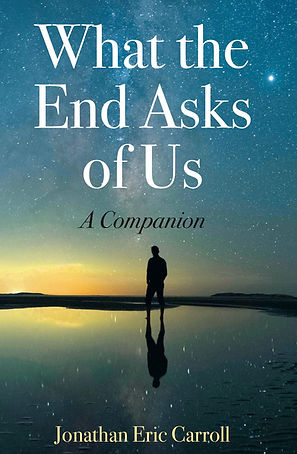
What the End Asks of Us:
A Companion
by Jonathan Eric Carroll
(Wisdom/Work, 2026)
"What the End Asks of Us is that rare combination: it is clear, unsentimental, and deeply humane; and it is informed and sensitive. Jonathan Carroll is an exceptionally clear expositor of philosophy, drawing on a wide range of thinkers and sophisticated ideas whose depth becomes ever more apparent as he applies them to the greatest problems that confront ordinary human beings. He refuses to sugarcoat death, and writes with equal seriousness for the dying, the grieving, and those who care for them, without condescending to any of them. The reflection questions alone are a goldmine; I look forward to drawing on them in my own philosophical counseling practice."
~ Samir Chopra, Author of Anxiety: A Philosophical Guide, &
Professor Emeritus of Philosophy, Brooklyn College & the CUNY Graduate Center
About the Book
What the End Asks of Us: A Companion offers philosophical company for the three conditions no life escapes: dying, grieving, and giving care. The book argues that honest presence, not resolution, is what these moments actually require, and that philosophy, practiced as accompaniment rather than argument, is equipped to provide it.
Grief and dying tend to arrive without a language for them. Most people face the end, their own or someone else's, having been offered theology they can't quite believe, or self-help promising stages and closure that never quite fit what they're living. Drawing on Stoicism, Existentialism, Phenomenology, and the Buddhist and Taoist traditions, Jonathan Eric Carroll sits with the actual texture of these experiences rather than managing them into something more comfortable, writing for all, including those who are religious, but perhaps especially for readers who come to these questions without religious faith, wounded by religion, or somewhere in the complicated middle.
Written by Jonathan Eric Carroll, a psychotherapist and philosophical practitioner in private practice, and former parish minister of twenty years, the book unfolds in five parts: a shared philosophical ground, then sections addressed directly to those who are dying, those who grieve, and those who give care, before gathering the threads of the whole. Each chapter closes with reflection questions built for solitary use, conversation, or group settings. Grounded in more than a hundred deaths accompanied and a decade leading a grief support group, this is a book for anyone facing their own mortality, anyone grieving a loss, and anyone caring for someone walking through either, which is to say, in one role or another, all of us.